
SOIA pilot · Built by 475 Cumulus
From a vehicle complaint to a service estimate
How 475 Cumulus built SOIA's pilot app to turn a driver's free-text vehicle issue into a structured service intake, diagnostic estimate, and scheduling handoff.
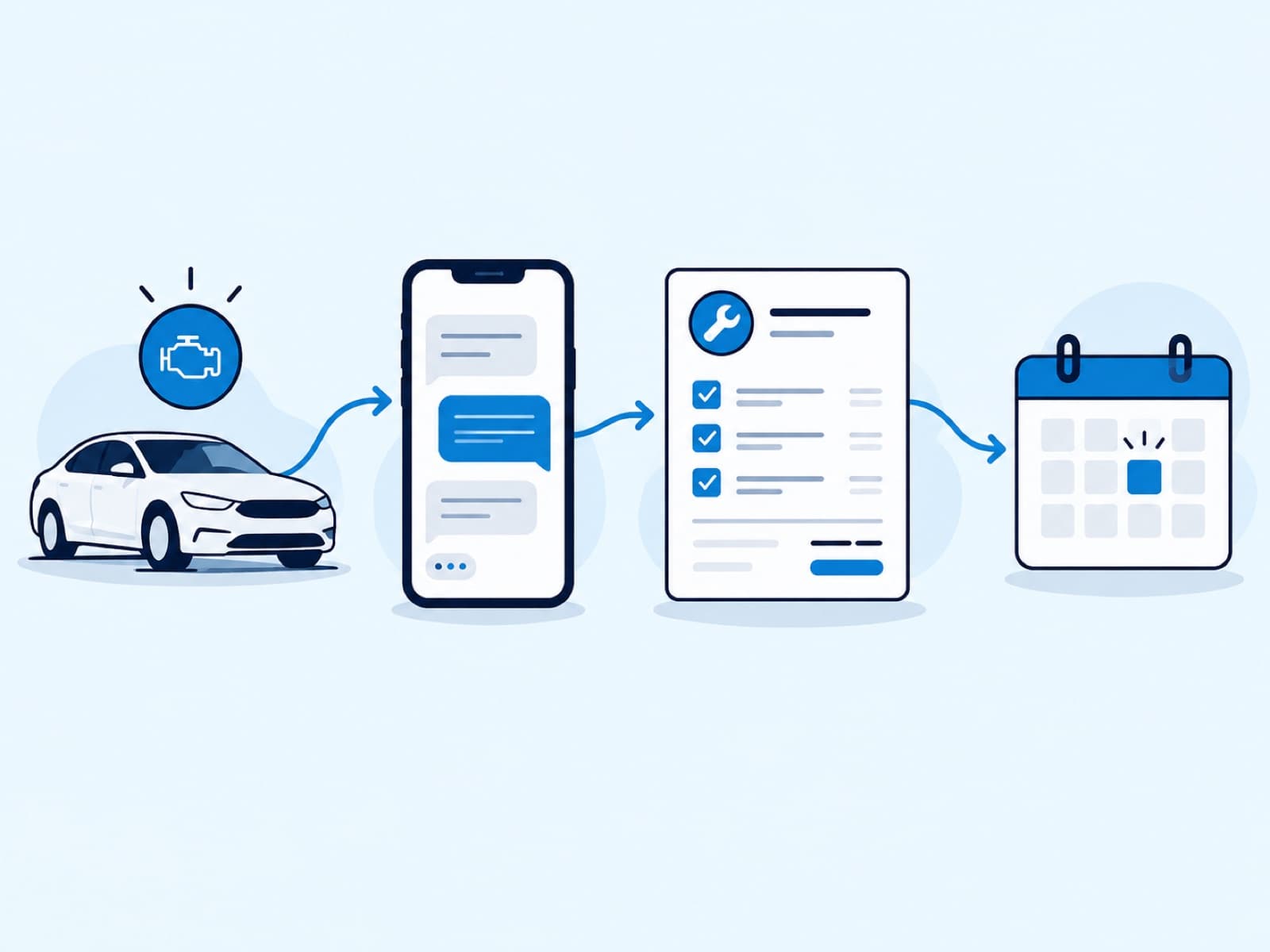
SOIA pilot project: from customer complaint to estimate and scheduling.
The problem
Vehicle service often starts with uncertainty. A driver may only know that "the AC doesn't work." The service team needs the vehicle, preferred shop, current mileage, symptoms, useful media, likely checks, a price range and a path to scheduling.
When that intake lives in unstructured messages, staff have to translate the customer's words into an operational case before the real work can begin.
What we built
For SOIA, 475 Cumulus built a pilot customer-facing app that connects an AI conversation to the service workflow.
The customer selects the vehicle and shop, confirms the current mileage and describes the issue in their own words. A customer copilot asks follow-up questions, structures what is known and unknown, and prepares a technician-ready case with possible causes for verification and recommended diagnostic steps.
An AI-powered estimator then uses internal APIs in a fixed sequence for parts prices and labor estimates. It returns a diagnostic range, and the customer reviews that estimate before continuing to appointment scheduling.
How the experience works
- Start with the vehicle, preferred shop and current mileage.
- Let the driver describe the issue in plain language.
- Ask structured follow-up questions and accept optional photos or video.
- Prepare a technician-ready summary with known facts, unknowns and verification steps.
- Use internal APIs for parts and labor inputs within a controlled estimation sequence.
- Show the diagnostic estimate before the customer chooses to schedule a visit.
A controlled AC test
In a controlled test of the pilot app, the only initial complaint was: "The car's AC doesn't work." The copilot asked when the issue started, how it began, what happens when the AC is on, whether the problem is constant or situational, whether anything else needed checking and whether media should be attached.
The app summarized the case without inventing missing details. It listed possible causes for technician verification, recommended diagnostic steps and produced a ₪354–₪708 estimate including VAT for an AC fault check.
The estimate was explicitly for diagnosis only. If the inspection found low refrigerant or a faulty part, a separate repair quote would be required. The test stopped before scheduling; no visit was booked.
Engineering for controlled AI
The estimator does not need to be described as an autonomous agent. Its internal API calls follow a fixed sequence, which keeps the operational path predictable while AI supports the service-estimation step.
PostHog supports AI analytics and general observability for the pilot. Together, these choices keep the focus on a controlled customer journey: structured intake, visible estimate logic and human confirmation before scheduling.
Why this matters
The useful part of AI here is not the chat window by itself. It is the connection between conversation, vehicle context, service knowledge, pricing inputs and the next operational step.
For service businesses, this pilot shows how AI can sit inside an existing customer journey instead of beside it. The goal is cleaner intake, clearer estimates and a better-defined handoff before work reaches the shop.
Project status
SOIA's app is currently in pilot mode. This article describes functionality verified in a controlled app test; it does not claim measured customer adoption, conversion, time savings or repair accuracy.
Build AI that reaches the workflow
If your product has a customer journey that still depends on unstructured messages and manual handoffs, 475 Cumulus can help design and build AI that fits the workflow, connects to your systems and keeps approval boundaries clear.
Related
Service
In-App AI Copilot Integration
In-app AI copilots integrated into your existing product views — context from product state, RBAC, and tenant data. Not a detached chat widget.
Service
AI Agent Development
Production AI agents and tool-calling integrated into your SaaS — orchestration that invokes your product APIs with permission checks, audit logs, and human confirmation gates.
Service
Classification & Extraction Integration
LLM-powered classification and structured extraction integrated into your product — ticket routing, entity extraction, and summaries governed by your schemas and validation rules.
Resource
In-app copilots: how to embed AI in your product without a sidebar chatbot
A practical guide to embedded copilots: context from product state, server-side assembly, RBAC, and UI patterns that fit existing workflows instead of a floating chat widget.
Resource
PostHog for AI observability: traces, errors, and session replay in one place
Use PostHog to debug LLM features end to end: model traces, errors, and session replay in one tool. How it compares with Langfuse, Sentry, and Datadog.
Resource
LLM middleware: what it is, why you need it, and how to implement it
A practical guide to the server-side layer between your app and the model — auth, rate limits, routing, logging, and the patterns that keep AI features production-ready.